
Hubbard County Court Records After Arrest
After a Hubbard County arrest, the Hubbard County Detention Center creates the jail booking record. Formal criminal court records begin when the prosecutor reviews the arrest facts and files charges in Hubbard County District Court. Minnesota uses county attorneys rather than the district attorney title. The Hubbard County Attorney is the local charging authority, and the county attorney FAQ states that the prosecutor decides whether criminal charges are filed or dropped. A victim may give input, but that input alone does not control charging or dismissal.
The court record after an arrest is therefore the filed case, not the booking row by itself. Booking data may list arrest allegations, custody date, bail or fine labels, and a court date if one has been entered. The case file shows the filed counts, case number, hearing events, public documents, disposition, and later changes. For custody and booking facts, use the Hubbard County jail inmate records. For the image link attached to a current booking, use the Hubbard County jail mugshots page.
Hubbard County District Court is part of the Minnesota Judicial Branch and the Ninth Judicial District. The court has original jurisdiction over criminal, traffic, juvenile, civil, family, and probate cases filed in Hubbard County. The public case path is local in venue but statewide in search access because Minnesota Court Records Online, often called MCRO, is the main public portal for case details and court documents.
Find Hubbard County Court Records
The main search tool for Hubbard County court records after a jail arrest is Minnesota Court Records Online Case Search. MCRO Case Search lets users search by person or business name, case number, citation number, or attorney name and bar number. The MCRO overview also describes Document Search, judgment search, and hearing search tools, but criminal case lookup usually starts with Case Search.
The screenshot below comes from the official MCRO Case Search page used for Hubbard County criminal case lookup.
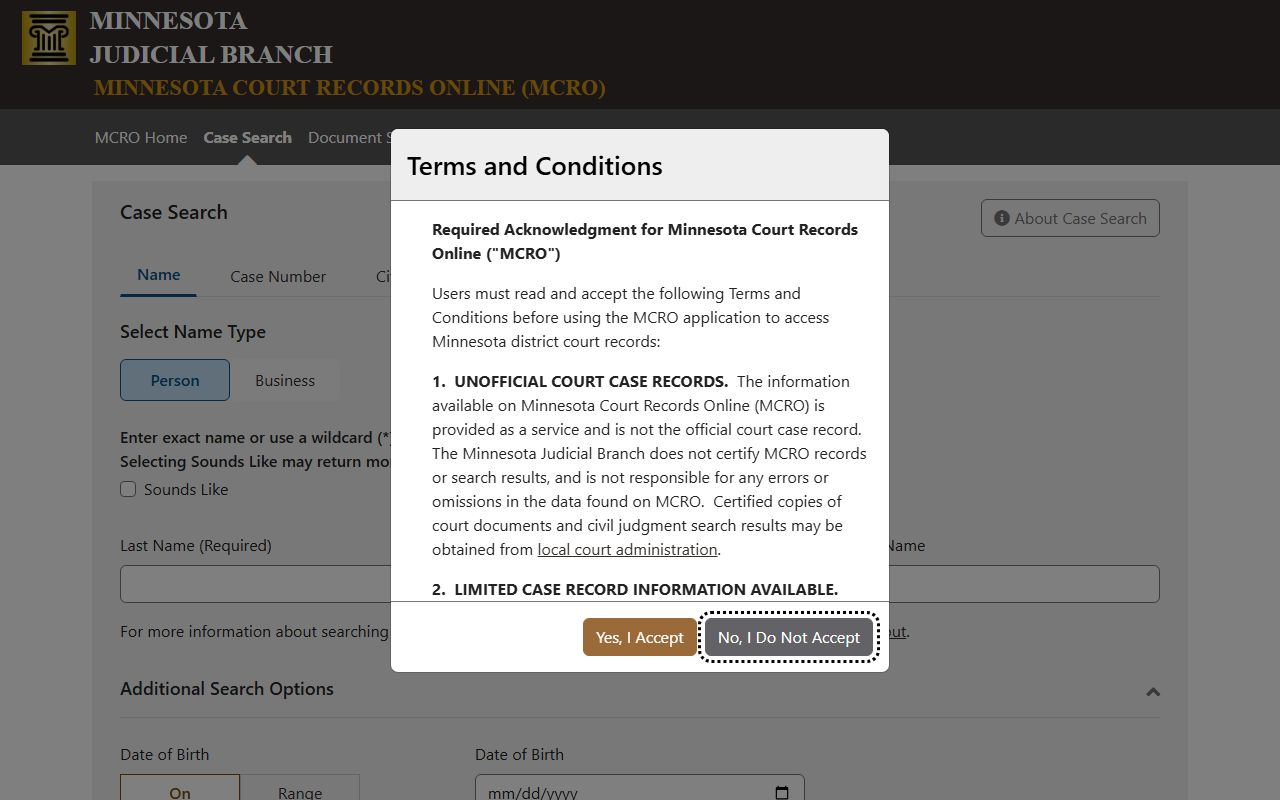
MCRO is the court-side search point, so it should be checked after the roster when a booking has moved into a filed criminal case.
| MCRO Field | Type | Required | Use in Hubbard County |
|---|---|---|---|
| Name | Search option and text | Depends on method | Use for defendant name searches when no case number is known. |
| Case Number | Search option and text | Depends on method | Hubbard criminal cases commonly use the 29-CR format shown on court calendars. |
| Citation Number | Search option and text | Depends on method | Useful for traffic or citation matters tied to an arrest or summons. |
| Attorney | Name or bar number | Depends on method | Can narrow results when counsel information is known. |
- Check the Hubbard County inmate locator for the name, custody date, court date, and booking details if the person is still in custody.
- Search MCRO by defendant name. Use a case number when the jail roster or court calendar provides one.
- Confirm the county and case type. Hubbard County criminal files generally appear with 29-CR in the case number.
- Open Case Details or Register of Actions to review charges, hearings, public documents, and disposition entries.
- Compare roster charges with court charges because the prosecutor may file, amend, reduce, dismiss, or add counts after booking.
Hubbard County Charging Records
Charging documents are the bridge between a jail arrest and a court record. The Hubbard County Attorney reviews law enforcement reports and decides whether to file a criminal case. A charging document states the accusations being brought to court, cites the offense, and starts the court path that can include a first appearance, arraignment, omnibus hearing, plea hearing, trial setting, disposition, or probation violation hearing. The daily court calendar fields noted in the research include party name, hearing location, hearing date, time, judicial officer, hearing type, connection type, and case number.
| Document | Filed By | Common Use | What It Starts |
|---|---|---|---|
| Complaint | Prosecutor, often based on law enforcement reports | Common criminal charging document in Minnesota cases | The filed case and the public charge record. |
| Information | Prosecutor | Used in some felony or later-stage charging contexts | A formal accusation without a grand jury indictment. |
| Indictment | Grand jury | Used for the most serious matters or where required | A felony court case based on grand jury action. |
Not every arrest leads to the same charge that first appeared at booking. A jail entry may reflect the arresting agency's initial offense label. The court file reflects what the prosecutor actually files. That difference matters when a person is booked on one allegation, later charged with a different count, or not charged at all.
Hubbard County Charge Status
Charge status can change many times after a Hubbard County jail arrest. A count may be pending at first appearance, amended after review, reduced during plea talks, dismissed by the court, or resolved by plea or verdict. MCRO is the place to check filed charge status, while the ProPhoenix roster is better for current custody and booking details. The Minnesota BCA Public Criminal History Search is a separate system that focuses on public criminal history and conviction data under Minnesota law, so it should not be treated as a full substitute for MCRO.
| Status | Plain Meaning | Why It Matters |
|---|---|---|
| Pending | The charge is filed and not yet resolved. | Hearings, release conditions, and warrants may still change. |
| Amended or reduced | The filed count was changed, replaced, or lowered. | The booking label may no longer match the active court charge. |
| Dismissed | The count ended without conviction on that charge. | A dismissal is not the same as an expungement. |
| Convicted | The charge ended in a guilty plea, verdict, or finding. | The case may then move to sentencing, probation, jail time, or DOC custody. |
Bail and First Appearance
Bond and bail are often addressed early in the court process, including at an initial appearance or first appearance. Hubbard County publishes detailed bail posting instructions because construction affects where and when cash bail is accepted. For Hubbard County charges during the construction period beginning June 30, 2025, cash bail may be posted Monday through Friday, 8:00 a.m. to 4:30 p.m., excluding weekends and holidays, at the Clerk of Courts Office. The county also states that bond may be posted through a Ninth Judicial District approved bondsman and that arrangements should be made before arriving at HCDC.
Bond data on the roster should be verified with the court or jail before anyone relies on it for release. The roster detail area includes a Bail/Fine label, but the sheriff's roster disclaimer says information may not be accurate and should not be relied on for legal action. Holds can also block release even when bail appears to be set. A detainer is a hold from another agency or court. A no-bond hold means payment alone will not release the person.
| Release Term | How It Works |
|---|---|
| Cash bail | Money paid directly when the court allows cash posting. |
| Surety bond | A release bond posted through an approved bondsman. |
| Personal recognizance | Release based on a promise to appear, often with court-set conditions. |
| No-bond hold | Custody continues because a court order, warrant, probation hold, federal hold, immigration hold, or other agency blocks release. |
Hubbard County Warrant Caveat
Warrants can be the reason a person is booked into the Hubbard County Detention Center, but the county currently has a key online-access limit. The official county "I want to find" page states that Active Warrant Information is currently nonfunctional because the Sheriff's Office transitioned to a new software suite for publishing the Warrant List and In Custody List. The in-custody list now routes to ProPhoenix, but the warrant list should not be described as a working public online search.
For warrant questions, the sheriff administration and records route remains important. The sheriff page says the office serves warrants, commitment papers, and court orders, and the administration page says it handles warrant information and civil process records. Call sheriff administration at 218-732-3331 during Monday through Friday business hours, or contact Hubbard County District Court at 218-732-5286 for case-specific court questions. A jail roster entry confirms custody after a warrant arrest, but it does not list every active warrant.
Charges, Convictions, Sealing
A charge is an accusation filed in court. A conviction is the result of a guilty plea, guilty verdict, or other finding that resolves the charge as proved. Hubbard County court records after a jail arrest may show both pending charges and completed dispositions, so the stage of the case has to be read carefully before drawing conclusions.
| Question | Charge | Conviction |
|---|---|---|
| Case stage | Filed accusation after arrest or summons. | Final or resolved finding on that count. |
| Proof level | Based on probable cause and prosecutor filing decisions. | Requires a plea, verdict, or court finding. |
| Public meaning | Does not prove guilt. | May appear in public criminal history where Minnesota law allows. |
Minnesota expungement law is also specific. Minn. Stat. 609A.015 covers Clean Slate automatic expungement for eligible records, while Minn. Stat. 609A.03 covers petition-based expungement. Expungement generally seals records from public access rather than proving that an arrest never happened. Eligibility depends on the offense, result, waiting period, and statutory limits.
| Record Treatment | Public View | Practical Limit |
|---|---|---|
| Sealed | Hidden from ordinary public court search access. | Certain agencies may still have access when law allows. |
| Expunged | Removed from public view under a court order or Clean Slate rule. | It does not force every third-party copy to vanish at once. |
| Dismissed but not sealed | May remain visible as a dismissed court event. | A separate expungement route may still be needed. |
Restricted Hubbard County Court Records
Public access is not unlimited. Minnesota Government Data Practices Act rules in Minn. Stat. chapter 13 presume government data is public unless a state or federal law classifies it another way. Law enforcement data under Minn. Stat. 13.82 includes public arrest data, but some investigative data, juvenile data, protected victim data, medical information, and sealed court records may be withheld or redacted. Court records after an arrest may also be limited by court rule, expungement order, or case type.
Older documents or records not visible in MCRO may require court records channels or a request to the correct agency. Booking records and law enforcement reports are not controlled by the court in the same way as the criminal case file. For sheriff-held booking, arrest, incident, or warrant data, use the Hubbard County Data Practices request page or the sheriff Records office. For case files, contact Hubbard County District Court.
Important: Casual court lookup is not an FCRA consumer report and must not be used for credit, employment, housing, insurance, or similar screening.